Climate Change Anomalies
The climate change is one of the greatest challenge faced by our generation. In order to better understand its impact, it is useful to look at empirical data. The objective of this project was to explore the temperature anomalies encountered in the last dozens of years.
First, we need to download some data from the NASA.
# Loading the data set
weather <-
  read_csv("https://data.giss.nasa.gov/gistemp/tabledata_v3/NH.Ts+dSST.csv",
           skip = 1,
           na = "***")
We will now make some modifications to it and analyze it. Let’s start by selecting the months from January to December and drop the “periods” variables.
tidyweather<- weather %>%
  select(Year,Jan:Dec) %>%
  pivot_longer(2:13, names_to="month",
               values_to = "delta")
Our tidyweather data frame has now three variables now, one each for
- year,
- month, and
- delta, or temperature deviation.
Plotting Information
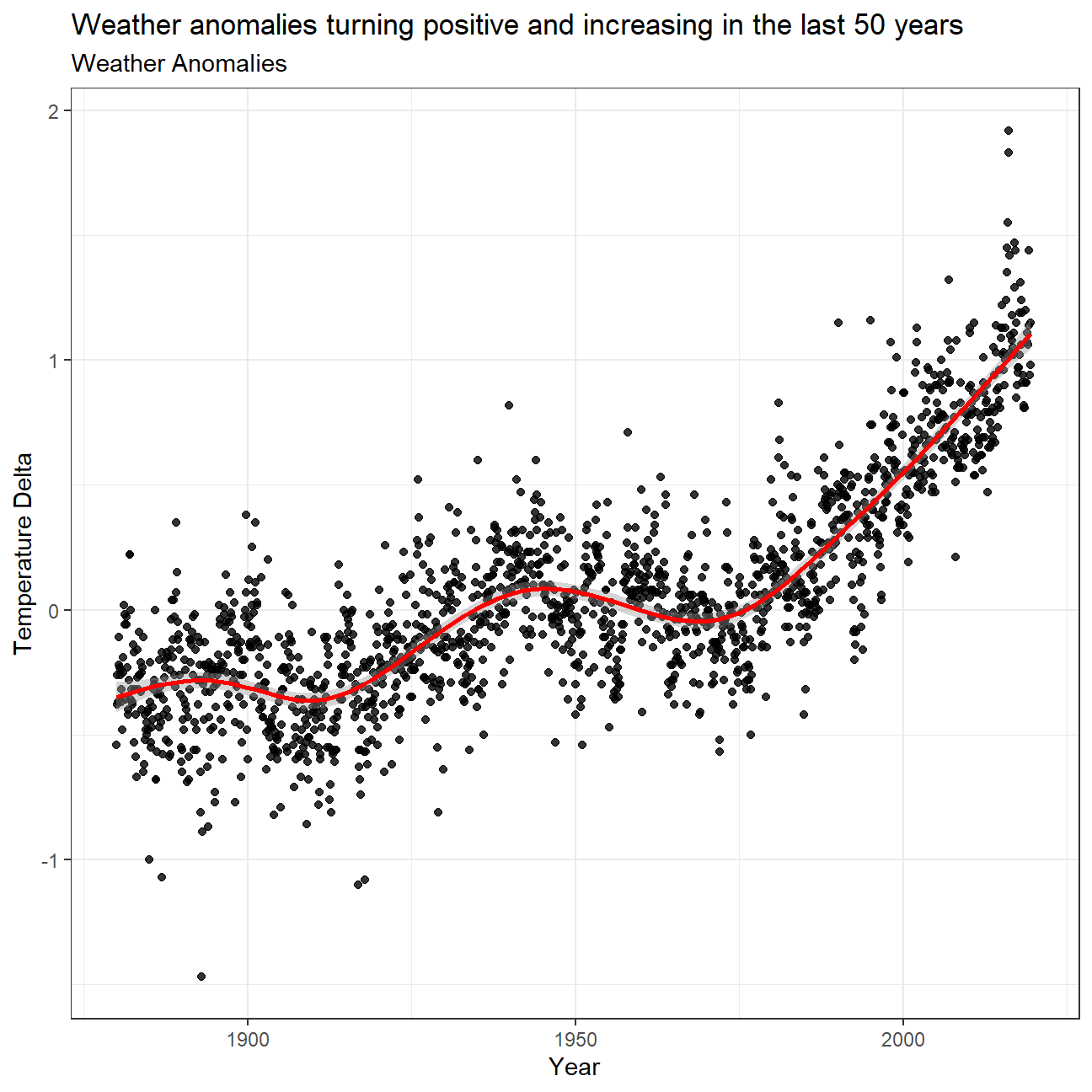
Let us plot the data using a time-series scatter plot, and add a trendline. To do that, we first need to create a new variable called date in order to ensure that the delta values are plot chronologically.
# Filtering the dates
tidyweather <- tidyweather %>%
  mutate(date = ymd(paste(as.character(Year), month, "1")),
         month = month(date, label=TRUE),
         year = year(date))

# Constructing the grpah
ggplot(tidyweather, aes(x=date, y = delta))+
  geom_point(alpha=0.8)+
  geom_smooth(color="red") +
  theme_bw() +
  labs (title = "Weather anomalies turning positive and increasing in the last 50 years",
    subtitle = "Weather Anomalies",
    x = "Year",
    y= "Temperature Delta"
  )
This trend could be different depending on the month. Thus we’ll have a look at the same kind of graph but this time faceted by month.
ggplot(tidyweather, aes(x=date, y = delta))+
  geom_point()+
  geom_smooth(color="red") +
  theme_bw() +
  labs (title = "Weather anomalies changes are constant throughout the months",
    subtitle = "Weather Anomalies",
    x="Year",
    y="Temperature Delta"
  )+
  facet_wrap(~month)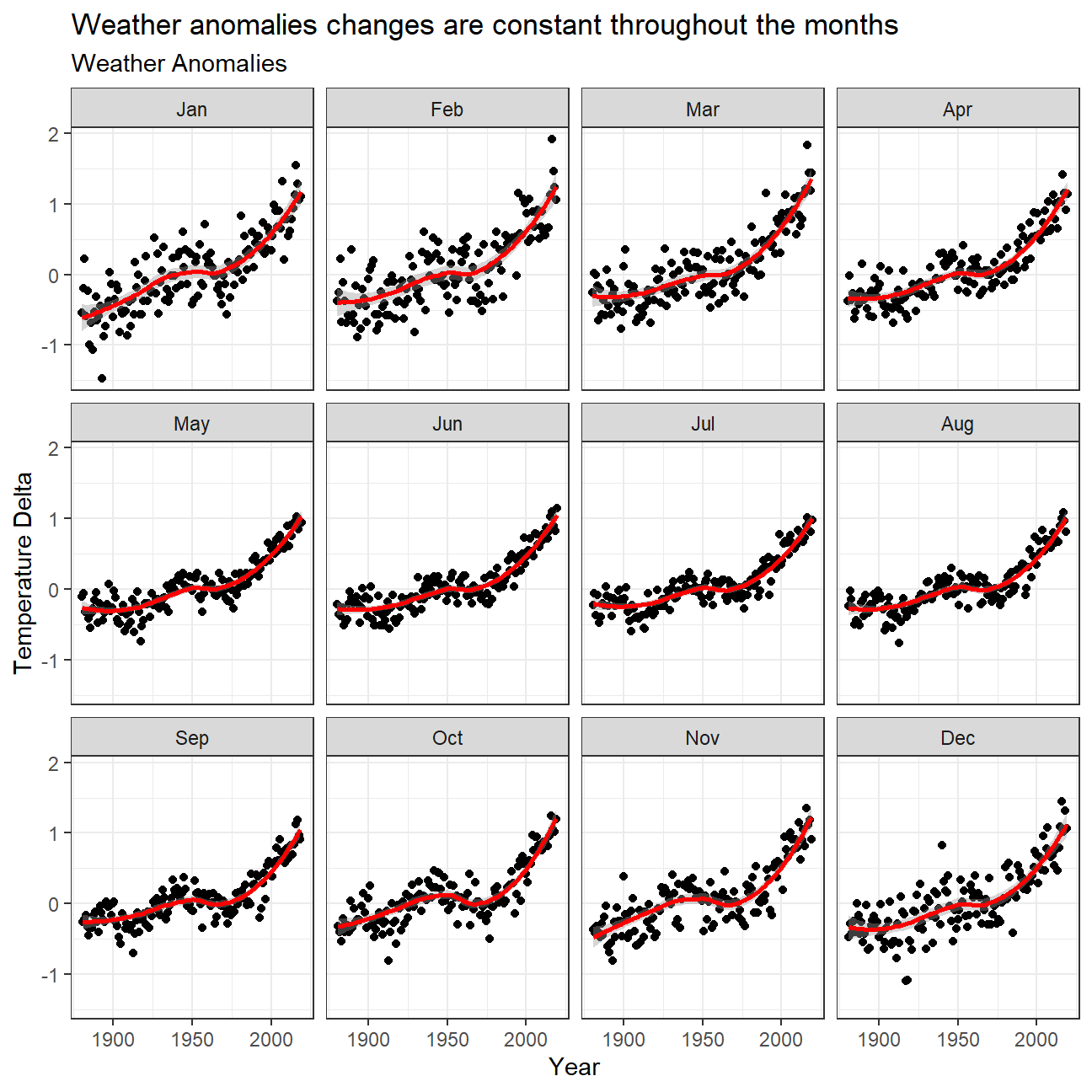
It is sometimes useful to group data into different time periods to study historical data. For example, we often refer to decades such as 1970s, 1980s, 1990s etc. to refer to a period of time. NASA calculates a temperature anomaly, as difference form the base period of 1951-1980. The code below creates a new data frame called comparison that groups data in five time periods: 1881-1920, 1921-1950, 1951-1980, 1981-2010 and 2011-present.
We remove data before 1800 and before using filter. Then, we use the mutate function to create a new variable interval which contains information on which period each observation belongs to. We can assign the different periods using case_when().
comparison <- tidyweather %>%
  filter(Year>= 1881) %>%     #remove years prior to 1881
  #create new variable 'interval', and assign values based on criteria below:
  mutate(interval = case_when(
    Year %in% c(1881:1920) ~ "1881-1920",
    Year %in% c(1921:1950) ~ "1921-1950",
    Year %in% c(1951:1980) ~ "1951-1980",
    Year %in% c(1981:2010) ~ "1981-2010",
    TRUE ~ "2011-present"
  ))
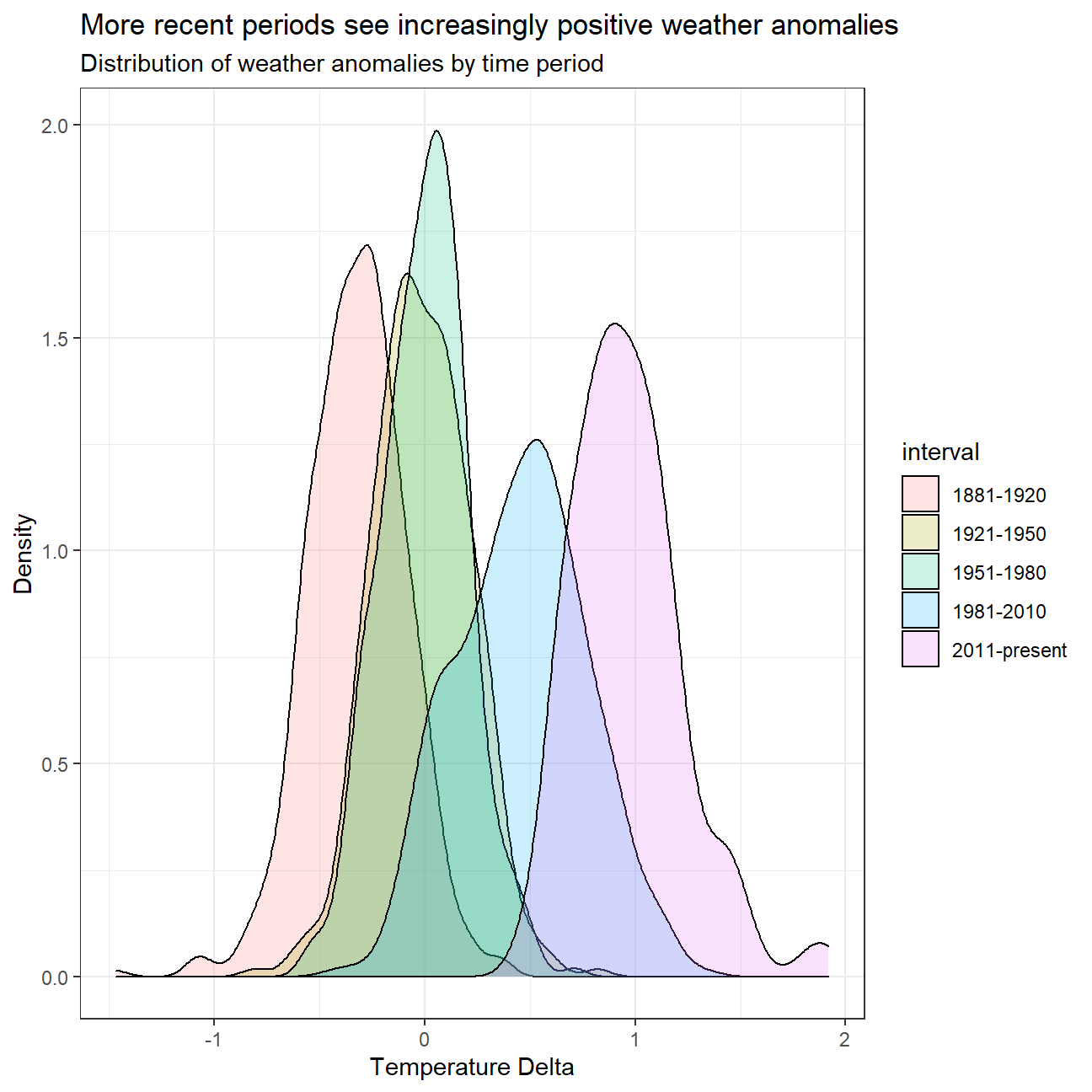
Now that we have the interval variable, we can create a density plot to study the distribution of monthly deviations (delta), grouped by the different time periods we are interested in.
ggplot(comparison, aes(x=delta, fill=interval))+
  geom_density(alpha=0.2) +   #density plot with tranparency set to 20%
  theme_bw() +                #theme
  labs (
    title = "More recent periods see increasingly positive weather anomalies",
     subtitle = "Distribution of weather anomalies by time period",
    y = "Density"         #changing y-axis label to sentence case
    ,x = "Temperature Delta"
  )
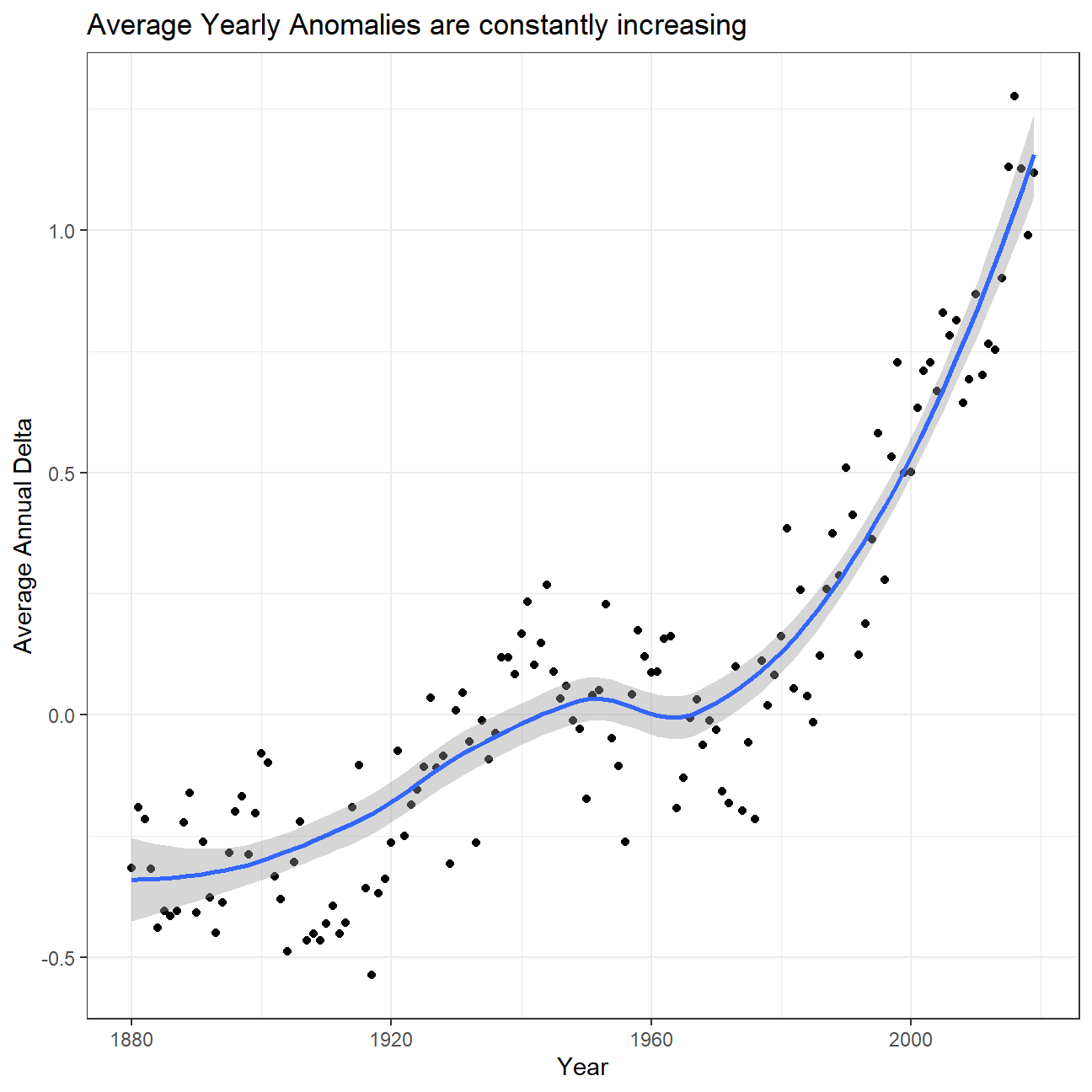
So far, we have been working with monthly anomalies. However, we might be interested in average annual anomalies. We can do this by using group_by() and summarise(), followed by a scatter plot to display the result.
#creating yearly averages
average_annual_anomaly <- tidyweather %>%
  group_by(Year) %>%   #grouping data by Year

  # creating summaries for mean delta
  # use `na.rm=TRUE` to eliminate NA (not available) values
  summarise(annual_average_delta = mean(delta, na.rm=TRUE))

#plotting the data:
ggplot(average_annual_anomaly, aes(x=Year, y= annual_average_delta))+
  geom_point()+

  #Fit the best fit line, using LOESS method
  geom_smooth() +

  #change to theme_bw() to have white background + black frame around plot
  theme_bw() +
  labs (
    title = "Average Yearly Anomalies are constantly increasing",
    y     = "Average Annual Delta"
) 
Confidence Interval for delta
We are now going to construct a confidence interval for the average annual delta since 2011, both using a formula and using a bootstrap simulation with the infer package.
formula_ci <- comparison %>%

  # choose the interval 2011-present
  filter(interval == "2011-present") %>%
  filter(!is.na(delta)) %>%
  # na.omit() %>%

  # what dplyr verb will you use?

  # calculate summary statistics for temperature deviation (delta)
  # calculate mean, SD, count, SE, lower/upper 95% CI
  summarise(mean_delta=mean(delta),
            sd_delta=sd(delta),
            count=n(),
            t_critical = qt(0.975, count-1),
            se_delta = sd(delta)/sqrt(count),
            margin_of_error = t_critical * se_delta,
            delta_low = mean_delta - margin_of_error,
            delta_high = mean_delta + margin_of_error)
  # what dplyr verb will you use?

#print out formula_CI
formula_ci %>% tbl_df %>% rmarkdown::paged_table()
# use the infer package to construct a 95% CI for delta
set.seed(1234)
boot_deltas <- comparison %>%
filter(interval == "2011-present") %>%
filter(!is.na(delta)) %>%
specify(response = delta) %>%
generate(reps = 1000, type = "bootstrap") %>%
calculate(stat = "mean")
percentile_ci <- boot_deltas %>%
get_confidence_interval(level = 0.95, type = "percentile")
percentile_ci %>% tbl_df %>% rmarkdown::paged_table()formula_ci %>%
select(delta_low, delta_high) %>% tbl_df %>% rmarkdown::paged_table()The mean delta over the last 10 years is 0.966 - a significant change based on NASA’s findings. Both confidence interval methods give almost comparable results. Looking at the bootstrap method, the 95% confidence interval is between 0.917 and 1.02. This means that when looking at weather anomalies, the vast majority will over around this “one-degree” change, meaning the climate is deregulated and this will have devastating consequences.